
Large-Scale Geologic Controls on Hydraulic Stimulation

Value to Sponsors
- Provides management and assessment teams quick-look guidelines from both existing production test data or the early design of operational data collection for evaluating basin scale to large acreage block scale
the stimulation considerations affecting the costs of completion that in unconventional plays can equal the costs of drilling a well. - Documents the value of understanding the tectonic setting and assessing the geologic signatures of the predominant North American shale plays in affecting costs of stimulation and providing a methodology to push effective decision and planning farther upstream for cost reduction of completions and maximizing recovery.
The deliverables for Phase 1 would include optimized decision tree recommendations for stimulation procedures under various geologic scenarios. They will be based on specific case studies that are evaluated and placed in the context of the range of major geologic controls, and stress regimes. We will develop a summary of the implications of the simulation programs, indicating potential operational insights that relate to well locations, drilling activities (if possible), and stimulation programs (where possible). The development of this interactive decision tree will contain guidelines and range of treatment conditions. It is meant to allow an intelligent first pass design to be combined with secondary options based on early results from pilot drilling. Participant guidance will be essential to outline deliverables.
Currently, the ability to estimate OGIP or OOIP often exceeds the ability to economically stimulate and extract this resource. This applies to many tight as well as ultra-low permeability formations, i.e. sands or shales. Improved simulation of hydraulic stimulation, amalgamating geologic texture with controllable engineering parameters could be of value.
Recognizing these advances, the goals of this proposed work program are to:
- More fully enfranchise geologic regimes in the stimulation design process.
- Move the stimulation methodology planning farther upstream.
- Develop diagnostic methods that realistically reflect the geologic environments of concern. These would be methods that could be used before, during, and after hydraulic stimulation.
- Assess geologic signatures that allow more rock to be exposed to recoverable stimulation fluids, to enable fracture aperture to be maintained and to do this with minimized or optimized volumes of treating fluids.
- Scenario Selection: Select four characteristic basins where information is reasonably available.
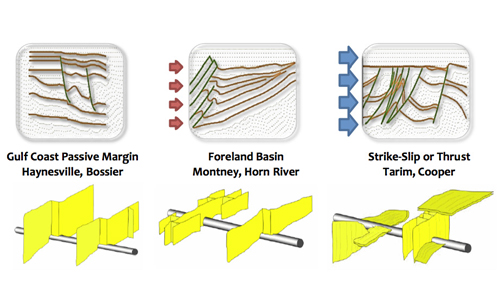
- Geomodel: Develop a preliminary geomechanical model for each play, based on logging and other data.
- Sub-Seismic Fractures
- Stress Distribution
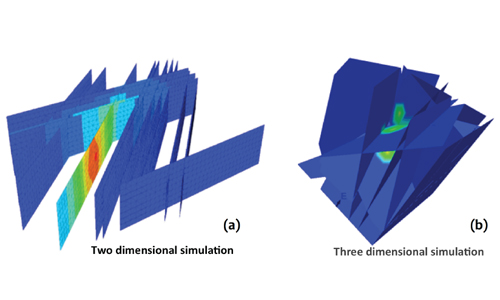
- Hydraulic Fracturing Simulations: Up to this point, a preliminary Geomodel has been developed. The next step would be simplifying the geomodel to incorporate essential features over a restricted geographic domain.
- Production Simulations: The created geometries will be weakly coupled with ARTS, the University of Utah’s reservoir simulator.
- Stress Sensitivity: Identify likely production controls associated with select characteristics.
Results
Participant guidance and oversight will add a great deal to the results of this project. This is research-oriented and is estimated to bear fruit in eighteen months. In addition to Sponsor update meetings and/or data downloads as needed, Sponsors will receive a written Final Project Report after Project completion.
Potential Work Program (Phase 2)
Longer term goals are to continue with more detailed simulations, increasing the complexity of the geologic network and the complexity of the coupling and reservoir simulations. Additional scope of work and deliverables would be identified and recommended as Phase 1 proceeds.