Message from the Director Milind Deo
Photograph, EGI Director of Operations Milind Deo

Message from the Director Milind Deo


Dear Friends and Colleagues: Greetings for a healthy and productive 2021 from the Energy & Geoscience Institute (EGI) at the University of Utah. I am delighted to write to you as the EGI Interim Director. I have been a Professor at the University for over 30 years and have been associated with EGI for most of its existence in Utah. I recently assumed the EGI directorship role from Dr. Raymond Levey who retired at the end of 2020 after over 20 years of service. Under his leadership, EGI has become a premier energy research institute in oil and gas, geothermal energy, and carbon management. I would like to thank Ray for his many contributions to EGI and to the University. As we all know, a confluence of unexpected and unforeseen events are today reshaping the energy landscape. EGI is well positioned to lead during this transition thanks to existing capabilities…

Read More

Dr. Raymond A. Levey Retires


A Legacy of Service, Innovation, and Dedication On January 1, 2021, EGI bid farewell to long-time EGI Director Dr. Raymond Levey.  Ray retired from EGI after 23 years with the Institute, first as Associate Director for two years, then as the second Director of the Energy & Geoscience Institute. He continues to support EGI and the University of Utah through his Research Professor faculty appointment in the College of Engineering. In an end-of-year conversation in December, we sat down virtually for a conversation and look back at his time at EGI and thoughts for the future in an evolving energy industry and global economic and environmental milieu. A Look Back Ray started at EGI in 1997 when he was recruited by the the University of Utah while serving as the Associate Director for International Programs at the University of Texas in Austin for the Bureau of Economic Geology which remains…

Read More

EGI Carbon Management Group Project & Research Updates


Paradox Basin Test Well Updates A 9,745 ft deep stratigraphic test well for the EGI Carbon Management Group’s Department of Energy-sponsored study “Improving Production in the Emerging Paradox Oil Play” has been successfully drilled, cored and logged by the project partner, Zephyr Energy.  Over 100 feet of core was collected from the Cane Creek interval, with additional sidewall cores sampled from the higher clastic zones of the Paradox Formation.  The core and petrophysical logs will be evaluated over the first half of 2021 to better characterize and understand the geology, petroleum system, and geomechanics of the Cane Creek and greater Paradox Formation. Utah Geological Survey Joins EGI in CUSP Partnership Last fall, the Utah Geological Survey (UGS) joined EGI in partnering on a project led by New Mexico Institute of Mining and Technology (NMT) and funded by the US Department of Energy’s National Energy Technology Laboratory (NETL).  The goal of the collaborative partnership is to…

Read More
image, logo, Utah FORGE

Utah Forge Drills First of Two Deep Wells


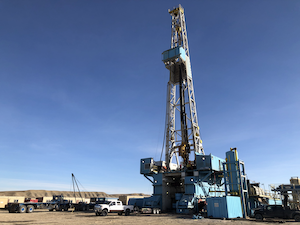
Reaching a milestone in its mission to prove a replicable, commercial pathway to EGS (Enhanced or Engineered Geothermal Systems), the Utah FORGE project announced in October 2020 that it had begun drilling on a first-of-its-kind highly deviated deep well. The well was drilled in hot, hard crystalline granite. The 11,000-foot total length well will reach a depth of 8,500 feet, at which point the temperature will be 440°. The team further updated its progress in early December when the well reached 7,320 ft MD and it is now drilling into the tangent section of the well; TVD at 7,031 ft. This type of well has not previously been used by the geothermal industry but rather was originated and perfected in oil and gas production.  The transferability of this technology to the application of clean, sustainable geothermal energy is a core research component of the Utah FORGE project. The Utah FORGE…

Read More
image, map, annotated, Cauvery Basin, India, Kanungo et al.

Newly Measured Outcrops Allow for Updated Biostratigraphy of Cauvery Basin


Dr. Sudeep Kanungo describes his recently published research, adding to our understanding of Cauvery Basin geology. Why we did it? The Cauvery Basin is an important Mesozoic depocenter of southern Asia (India) with a well-developed Cretaceous marine sedimentary succession and paleontological diversity. The basin is known for its Cretaceous petroleum system and has been commercially explored for hydrocarbons. This calls for continuously improving the stratigraphic constraints and correlation of the basin using the best possible chronostratigraphic resolution. What did we do? We have upgraded the Albian to Turonian calcareous nannofossil biostratigraphy of the Cauvery Basin using two newly measured outcrop sections and tied it with recently published ammonite stratigraphy (Gale et al., 2019), offering a higher resolution than obtained previously. In this manner, two of the best-known Cretaceous fossil groups, i.e., calcareous nannoplankton and ammonites, have been tied together to produce a robust biostratigraphy of the basin. What did we…

Read More
photograph, headshot, male

Geoscience from Superbasins to Shale Sweetpots


Dr. Rasoul Sorkhabi Interviewed in AAPG Explorer The January and December 2020 issues of the AAPG Explorer published featured interviews with EGI Research Professor Rasoul Sorkhabi. In the January issue as part of a feature article entitled “Basin and Superbasin,” by Heather Saucier, Sorkhabi remarks that “there are 1,050 giant and supergiant fields in the world. From those, 470 are located in the Middle East and in the former Soviet Union. However, there is super basin potential everywhere if you add shale.”  In the December article entitled “Oil Tech Research Goes Beyond Just Big Data,” by author David Brown. Sorkhabi comments on the coming energy transition, saying “The 2020 pandemic has affected every facet of the petroleum industry and has set in motion several long-standing trends in the petroleum industry. These trends will push the existing science and technologies in new directions, and the petroleum industry will have to evolve…

Read More
graphic image, logo, text, save the date

Save the Date for AAPG ACE 2021 in Denver, Colorado


EGI is looking forward and planning for AAPG ACE 2021. Save the date now, and plan to meet EGI in Denver. Whether we’re on-line or on-site, EGI will be there! May 23-16 in Denver, Colorado. This year AAPG is moving forward with ACE, planned as an in-person event with a hybrid component for those unable to travel.  While coronavirus conditions across the US remain in flux, AAPG is planning to offer a hybrid model to allow participants and exhibitors the opportunity to be a part of the event whether they are able to join in-person or through a virtual conference portal. Have questions for us ahead of time? Send an email to contactEGI@egi.utah.edu. Looking back at the unique challenges of 2020, it sometimes seems a wonder that Conferences and Events continued to be held.  Even more remarkable is the high-quality presentations that we have come to rely on from in-person…

Read More
photograph, headshot, male,

Dr. Joe Moore at Utah Governor’s Economic and Energy Summit


A View of the Energy Technology and Innovation Outlook from Utah On October 26, EGI Research Professor and Utah FORGE Managing PI Dr. Joseph Moore spoke to the Utah Governor’s Economic and Energy Summit as part of the Energy Technology and Innovation Outlook breakout session. His discussion highlighted the fundamentals of geothermal energy and details of Utah FORGE project research to date. The Utah FORGE project is a ten-year project of over $200 million which will function as a dedicated site for technology development and public education on geothermal energy in general and EGS development in particular. Dr. Moore serves on the project management team as the Managing PI. He has participated in DOE projects since the mid-1970s. He holds appointments at the University of Utah as a Research Professor in the Department of Civil and Environmental Engineering and as an Adjunct Professor in the Department of Geology and Geophysics.…

Read More

2020 Governor’s Energy Pioneer Awards


Last fall, just before his 2020 retirement, former EGI Director Raymond Levey was awarded the Utah Governor’s Office of Energy Development (OED) 2020 Energy Pioneer award. The award recognizes Dr. Levey’s significant contributions to the energy sector in Utah and to the State of Utah.  Dr. Levey is in good company with fellow awardees, Laura Nelson-Walje, Franz Kolb, Rick Allis, and Irene Hansen, all experts in their fields and individuals with whom EGI, and Dr. Levey, have had longstanding relationships. The Governor’s Office of Economic Development (GOED), Governor’s Office of Energy Development (OED), World Trade Center Utah, and Salt Lake Chamber presented Gov. Gary R. Herbert’s Utah Economic & Energy Summit on Monday, Oct. 26, 2020, at The Grand America Hotel. During what was an unprecedented year in so many ways, the 2020 Summit and Awards were presented virtually. Read More

The Azolla Story Published as E-Book


EGI congratulates our colleague and Affiliate Scientist, Dr. Jonathan Bujak, and his co-author Alexandra Bujak, on the publication of their book The Azolla Story.  The book is available to all for download as an E-book. Dr. Jonathan Bujak has more than 40 years experience studying modern and fossil pollen, spores, and dinoflagellates (palynomorphs) within a geological, oceanographic, and climatic context. He has studied hundreds of wells and sections from the northeast Atlantic region and is the designated expert for North Sea and Faroe-Shetland equity disputes. Dr. Bujak was involved with the only two expeditions to core sediments beneath the North Pole – the 1979 shallow Lomonosov Ridge Expedition (LOREX) and the 2004 Arctic Coring Expedition (ACEX), which discovered the Eocene ‘Arctic Azolla Event.’ His work is widely featured in geoscience publications, television, and radio, including Nature (2006), GEO ExPro Magazine (2007, 2013), and Geoscientist Magazine (2014), as well as BBC…

Read More

EGI Staff & Affiliate Scientist Publication Updates


EGI Scientists are active researchers, publishing and presenting not only through cost-shared research at EGI, but in peer-reviewed journals, scientific conferences and presentations, and professional organizations. Milind Deo Goral, Jan & Deo, Milind. (2020). Nanofabrication of synthetic nanoporous geomaterials: from nanoscale-resolution 3D imaging to nano-3D-printed digital (shale) rock. Scientific Reports. 10. 10.1038/s41598-020-78467-z. Panja, Palash & Goral, Jan & Deo, Milind & McLennan, John. (2020). Prediction of Geomechanical Properties from Elemental Analysis using Machine Learning Algorithm. Conference: 54th US Rock Mechanics/Geomechanics Symposium at: Golden, Colorado, USA, June 2020. Rich Esser Xiao, Ting & McPherson, Brian & Esser, Rich & Jia, Wei & Dai, Zhenxue & Chu, Shaoping & Pan, Feng & Viswanathan, H.. (2020). Chemical Impacts of Potential CO2 and Brine Leakage on Groundwater Quality with Quantitative Risk Assessment: A Case Study of the Farnsworth Unit. Energies. 13. 6574. 10.3390/en13246574. Xiao, Ting & Xu, Hao & Moodie, Nathan & Esser, Rich…

Read More

Message from the Director


As we’re looking into Quarter 4 and the home stretch of 2020, there’s very little that turned out how we could have predicted on January 1, 2020. Despite the challenges and transitions across the energy industry and the globe, we remain grateful that by and large, our staff, researchers, University and government partners, and corporate members remain safe and dedicated to the work at hand. The last few months have been busy and productive, even with a quieter than normal campus atmosphere. Since our last issue, EGI staff and researchers have launched new projects and developed relationships for new ideas and research; they have embraced a new age of virtual meetings and conducted remote training and education courses for our members. And, as part of a Tier One research University, EGI has continued to take on a critical role in supporting students, colleagues, and early career professionals in navigating the…

Read More
image, logo, AAPG ACE 2020

Connect with EGI at the AAPG ACE 2020 Virtual Conference!


The postponed AAPG ACE 2020 is on for September 29 – October 1! This year’s conference is being held all on-line and EGI is looking forward to engaging with members and visitors again. Though we don’t get to see you in person, your questions, ideas, and comments are always valuable to us and help guide us as we pursue the research and services you depend on. EGI’s virtual exhibit booth is available all four days of the conference and will offer a variety of options for interacting with us— from live video presentations, technical talks, and on-demand pre-recorded topical videos, to downloadable resources and live chats or Zoom meeting appointments. ACE 2020—including exhibitor booths— will be available to registered participants on-demand through the end of 2020. EGI will make most of our exhibitor content and resources available to EGI members after the conference at egi.utah.edu. In addition, EGI Research Scientist…

Read More

Core through Pore: EGI Research Services Available to Members


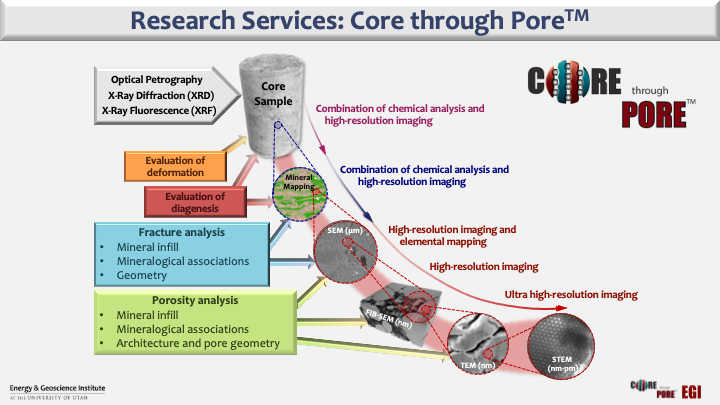
EGI’s Research Service Capabilities, encompassed under the term Core through Pore™, include techniques related to petrology, geochemistry, geomechanics, and flow dynamics— the data from which has helped generate reports on sedimentology, petrology, thermochronology, geochronology, and inorganic geochemistry across Europe, Asia, Oceania, Africa, North America and South America. Recent publications utilizing research services have included mineralogical/petrological, geological, and geochemical studies across a diverse range of geological settings related to both academic and industry work, ranging from basin tectonics and sedimentology to small-volume magmatism and geothermal energy. Techniques within research services fit within a progressive workflow for geological and material science samples which involves the use of optical microscopy and X-ray diffraction (XRD)/X-ray fluorescence (XRF) through to the use of scanning electron microscopes for mineralogical mapping and the progressively higher-resolution techniques of focused ion beam scanning electron microscopy (FIB-SEM), and transmission electron microscopy (TEM). Starting with optical microscopy, recent projects have included…

Read More

Making the Most of Your EGI Membership!


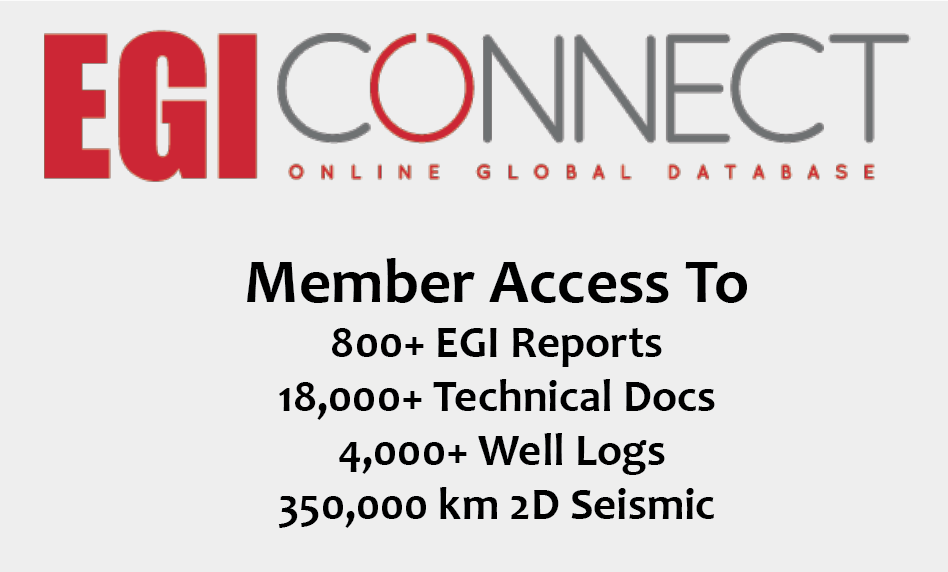
All EGI Members Have Access to EGIconnect Is your company a member of EGI? Are you and your colleagues making the most of your benefits as a member? All member company staff have access to EGIconnect, for EGI’s report and data library with over 800+ project reports completed by EGI scientists, 18,000+ geoscience and industry-related technical documents, 4,000 international wells and logs, and 350,000 km of 2D seismic exploration data from over 30 basins. If you have not registered for EGI connect, you may do so using your company email address. Step 1: Register and create a user profile using your company email address Step 2: Click the link in the confirmation email Step 3: Log in at EGIconnect.com EGI is available to help curate the most targeted, relevant data to your research question. For more information about this research service and how to get the most value from our…

Read More

New Research Opportunity: Red Sea and Gulf of Suez Basins Research in Development


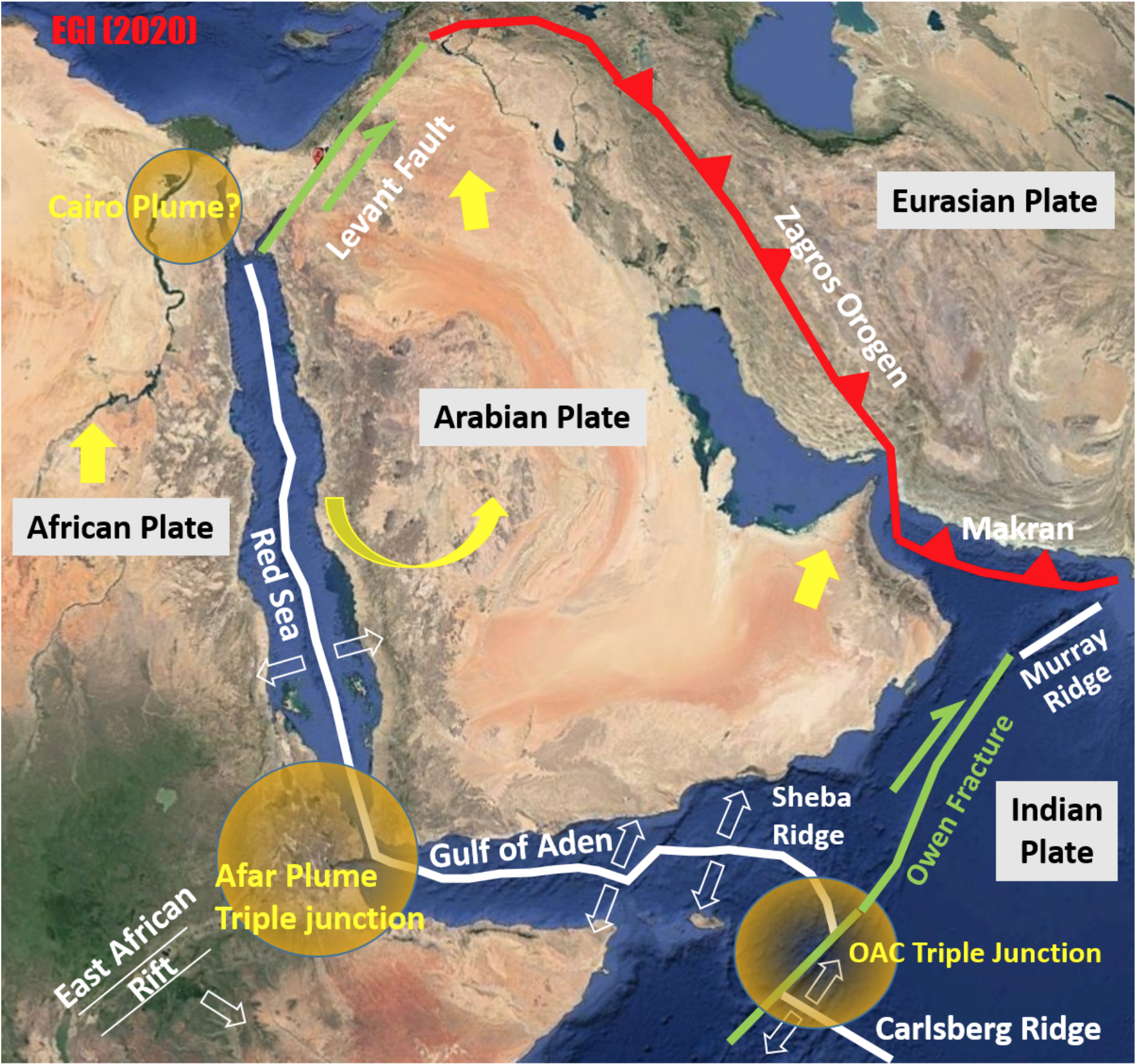
Figure 1. Plate tectonic setting of the Red Sea Basin. In recent years, there has been a renewed interest in petroleum exploration in the Red Sea Basin, both because of its infrastructures (proximity to Europe and offshore transportation) and successes in the Midyan and Jaizan basins (discovered in the 1990s and located respectively in the northern and southern ends of coastal-offshore Saudi Arabia). Dr. Rasoul Sorkhabi has recently released a new In Development project proposal focusing on the Red Sea Basin and Gulf of Suez Basin with an eye to better understanding the tectono-sedimentary evolution of the Red Sea and Gulf of Suez basins for petroleum exploration with a focus on key petroleum systems elements from source rocks to traps. The proposal also includes an ArcGIS quick assessment and easy-to-use tool for analysis of petroleum plays in the region based on an integrative database that can be augmented to the…

Read More